

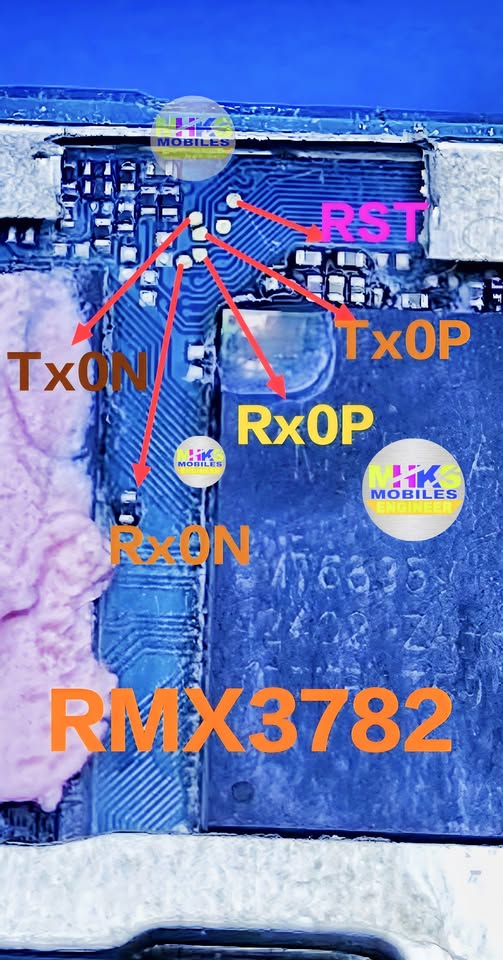
Here’s what **is currently known — and not known — about the ISP (UFS) pinout for the Realme Narzo 60x (RMX3782):
📌 Storage Type
- The Realme Narzo 60x (RMX3782) uses UFS 2.2 storage, not eMMC.
⚠️ UFS vs eMMC & ISP Availability
- Many Realme devices that use UFS storage have dedicated UFS ISP/Test points that allow tools like UFI Box, Easy-JTAG Plus, Medusa, etc. to access the UFS chip for low-level flash and repair operations.
- However, UFS ISP/Test point locations are often board-specific and not standardized like eMMC signal pads — and generally pinout diagrams are not publicly published in text form for this Narzo model online.
📍 Public Hunting Results
- Some community posts and images shared online show an “ISP Pinout UFS” reference for RMX3782, but all are image-based and hidden behind login walls on forums or Facebook posts. These are not accessible in plain text and thus cannot be reliably transcribed here.
- Another similar thread exists but likewise requires forum membership to see — and no downloadable pin diagram is openly posted.
🔍 What a Typical UFS ISP/Test Point Set Looks Like
For UFS devices (based on general Realme UFS guides), the core test points you’d expect on the motherboard near the UFS chip are:
- CLK – Clock
- TXOP / TXON – Transmit differential pair
- RXOP / RXON – Receive differential pair
- GND – Ground reference
- (+ sometimes VCC/VCCQ)
These are the four differential pairs plus clock and ground often used for UFS ISP access with boxes that support UFS.
⚠️ Important: The Narzo 60x’s exact physical test pad locations vary by board revision. Without a pin diagram image, you cannot reliably solder jumpers.
🔧 Typical Steps to Find / Use the ISP Points (General Guidance)
If you want to physically locate them, here’s what most technicians do:
- Open the back cover and shield, exposing the mainboard around the UFS chip.
- Use a high-magnification microscope to find tiny unlabeled test pads near the UFS chip BGA.
- Check for four differential lanes + clock + ground pads, then carefully test continuity before soldering.
- Connect to a UFS-capable hardware box (UFI Box, Easy-JTAG Plus with UFS board/adapter).
- In the box software, select UFS direct flash/ISP mode to identify the chip.
These ISP points are NOT the same as normal USB/EDL test points — they allow direct memory access.
📌 Summary
- Realme Narzo 60x (RMX3782) has UFS storage.
- There is no official open pinout diagram published in text form online at this time — only community-shared images behind logins.
- The expected UFS ISP signals are typical differential pairs and clock + ground, but their exact board positions must be located visually or via service schematics.
💡 Options to Proceed
If you need the exact pinout/test points:
- Obtain the board schematic for Narzo 60x RMX3782 (official service manual).
- Ask or register on GSM repair forums that host the ISP diagram images.
- Use a high-end box (UFI/Easy-JTAG) with automatic UFS pin detection if supported.
If you’d like, I can help you find schematic diagrams or instructions on how to join one of the communities where the actual UFS ISP image for RMX3782 is shared — just let me know!