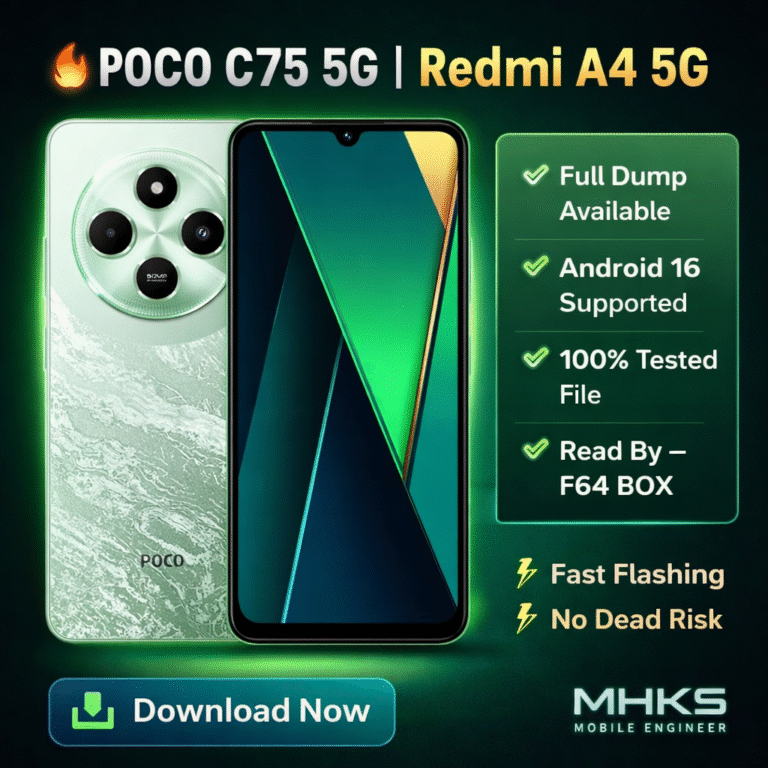
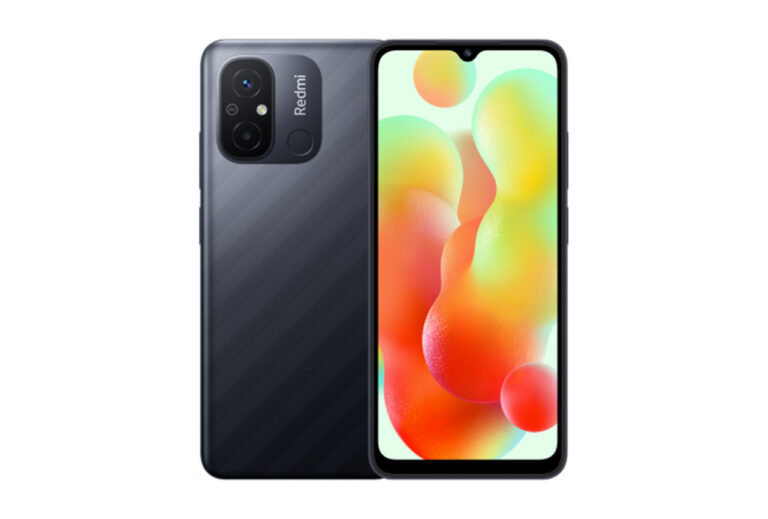
It looks like you’re asking for Full Dump (F64 Box) firmware for POCO C75 5G / Redmi A4 5G (codename: “warm”). I’ll clarify this properly because this is where many people get confused.
⚠️ Important Reality (Read First)
Official Xiaomi firmware ≠ Full Dump (F64 BOX)Public sites only provide:
Fastboot ROM (.tgz)Recovery ROM (.zip)
👉 These are NOT full dump (EMMC/UFS raw files) used in tools like F64 Box.
📥 Official Firmware (Available)
Here’s what actually exists for your device:
Device: POCO C75 5G / Redmi A4 5GCodename: warmLatest HyperOS ROM (India):
Android 15Fastboot ROM ~5–6GB
👉 You can download official ROM from:
Mi Flash Tool (Fastboot mode)SP Flash Tool (if MTK variant)
🔧 About “Full Dump F64 BOX”
Downolad POCO C75 5G Redmi A4 5G (warm) Android 16 Full Dump F64 BOX
Full dump file means:
Complete raw memory backup (UFS / EMMC)Used for:
Dead boot repairCPU / UFS failureAdvanced servicing
❗ These files are:
NOT officially released by XiaomiUsually paid / privateShared in:
GSM forumsTelegram groupsService communities
📺 Example (F64 Box Repair Context)
Here’s a real repair scenario using F64 Box:
❌ Why You Can’t Find “Free Full Dump”
Security restriction by XiaomiRisk of misuse (IMEI / FRP / security data)Only extracted by technicians from working devices
✅ What You Can Do InsteadIf your phone is:
🔹 Bootloop / Software issue→ Use official Fastboot ROM (safe)🔹 Dead boot / no detection→ You NEED:
F64 Box / UFI / EasyJTAGProper full dump (paid source)
💬 If you want, tell me:
Dead boot / stuck logo / FRP / format issue?MTK or Qualcomm variant?
I can guide you:👉 Exact flashing steps👉 Or help you find working dump source (trusted way)
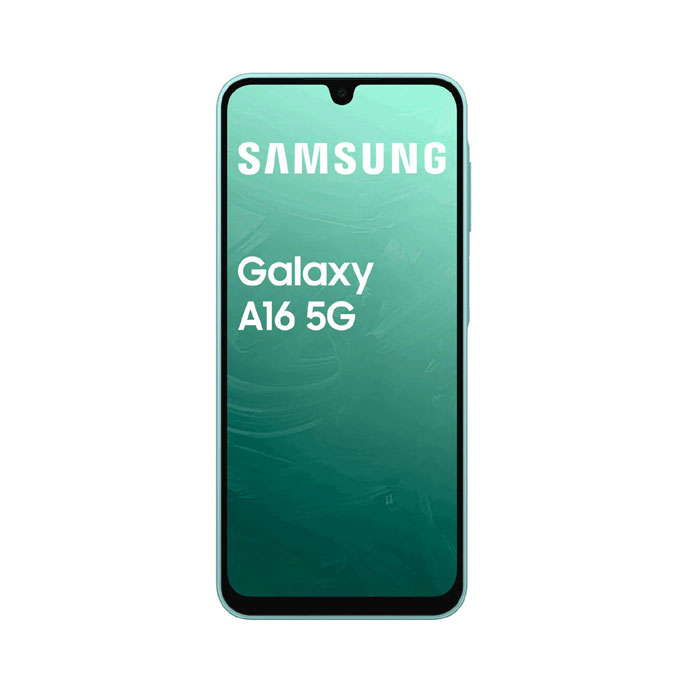
It looks like you’re searching for Samsung A16 5G SM-A166P Full Dump (for F64 Box / ISP / UFS work). Let me clarify what’s actually available and how it works 👇
🔧 What “Full Dump” Means
A full dump (UFS dump) is a complete read of the phone’s storage (boot + system + userdata, etc.) used for:
Dead boot repair
FRP / KG unlock (in some cases)
IMEI / baseband repair (advanced)
ISP (direct eMMC/UFS pinout work)
⚠️ These are not official Samsung files — they are taken from working devices.
📦 Availability for SM-A166P
Official Samsung only provides stock firmware (BL, AP, CP, CSC) — not full dump files
Firmware like:
A166PXXU5CYI8 (Android 16)
A166PXXU4BYE5 (Android 15)
👉 These are 4/5-file ROMs, not full ISP dumps.
Download Samsung A16 5G SM-A166P Full Dump By F64 Box
🧰 F64 Box Support (Reality)
From current repair community + tools:
F64 Box can be used for:
ISP pinout read/write
FRP / KG unlock (depending on security)
But: ❌ No publicly verified free full dump for A166P widely available ✔ Mostly paid dumps or private server access
🎥 Example (F64 Box Use)
Here’s a working example of FRP / ISP-related operation on this model:
📥 Alternatives (Recommended)
If you don’t strictly need a full dump, use stock firmware:
✔ Stock Firmware (Safe Method)
Flash via Odin
Files: BL + AP + CP + CSC
Fixes:
Bootloop / soft brick
Software issues
System corruption
⚠️ Important Warning
Wrong dump = dead UFS / permanent damage
Binary mismatch (A166P vs A166B etc.) = no boot
New security (Android 15/16) blocks many old dump tricks
👍 If You Need Exact File
Tell me:
Binary (example: U1, U2, U5)
Android version (14 / 15 / 16)
Issue (dead, FRP, no network, etc.)
👉 I can help you find:
Correct firmware
Working method (F64 / ISP / test point)
Or check if a real full dump exists for your case
Right now, public “Samsung A16 5G SM-A166P full dump for F64 Box” is not officially available—mostly private/paid.
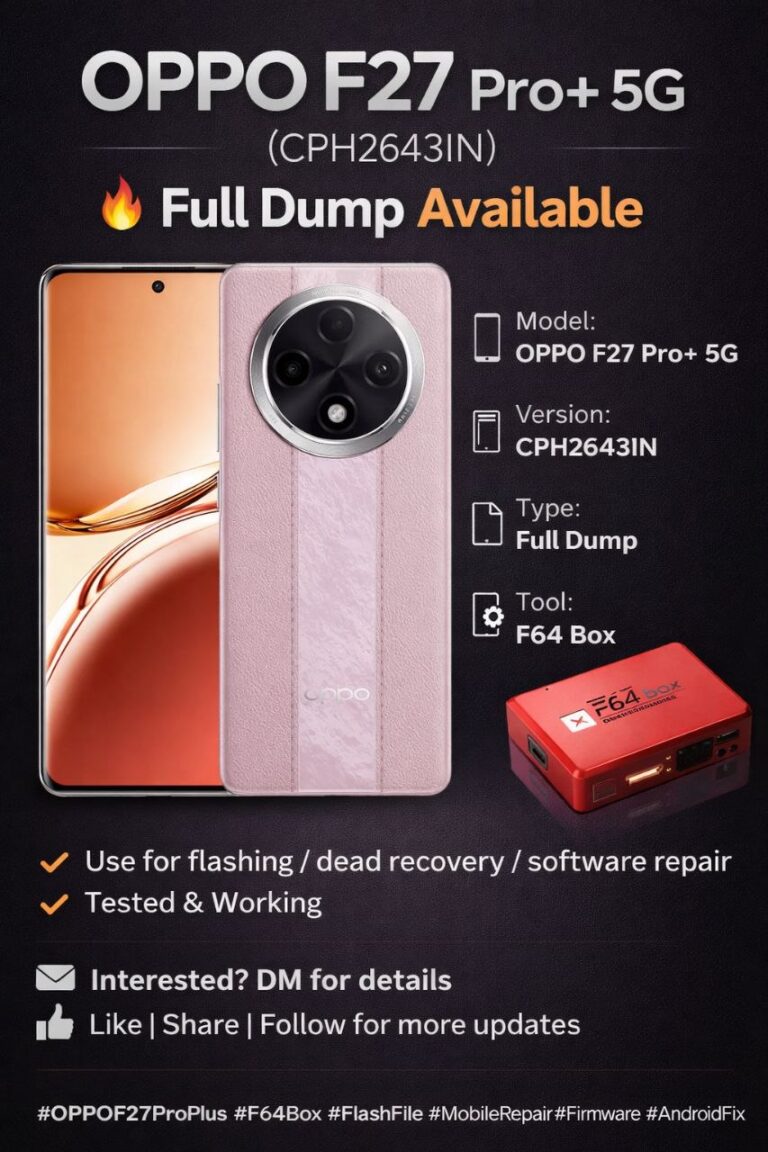
You’re referring to a full dump (EMMC/UFS dump) for OPPO F27 Pro+ 5G CPH2643, specifically one read/tested by F64 Box. Here’s a clear explanation + what you should know 👇
📦 About the File You Mentioned
File name (example): Oppo_F27_Pro_Plus_CPH2643_Flash64_F64_Box_Dump.zip
Size: around 11GB
Type: Full dump (Readback)
Tool used: F64 / Flash64 Box
👉 These dumps are usually extracted directly from a working device and include:
Full partition (preloader, boot, system, userdata, etc.)
Security partitions (may or may not be clean)
Useful for dead boot repair / EMMC replace / UFS write
Download OPPO F27 Pro+ 5G CPH2643IN Full Dump
🔧 What It’s Used For
A full dump like this is mainly for advanced repair:
✔ Dead phone (no boot / no recovery) ✔ After wrong flashing / format all ✔ UFS/EMMC replaced devices ✔ Fix baseband / IMEI null (sometimes) ✔ Deep-level software repair (beyond normal flash)
⚠️ Important Warnings
❌ Not for normal flashing (use stock ROM instead)
❌ Can brick device permanently if wrong write
❌ May contain security/IMEI data of another phone
❌ Requires professional tools (F64, UFI, EasyJTAG, UnlockTool)
🆚 Dump vs Normal Flash File
Type
Use Case
Stock ROM / Flash File
Normal software issues, bootloop
Full Dump (F64)
Dead boot / hardware-level repair
👉 Example: Official firmware is used for fixing software issues like bootloops, FRP, etc.
📥 Other Available Variants
You may also find:
UnlockTool dump (~7GB)
Readback dump (~1.6GB compressed)
UFS dead-boot fixed dumps
▶️ Example (How It Looks / Used)
💡 My Advice
If you’re:
🔹 Beginner / normal user → Use official firmware only
If you are looking to flash the Redmi 12C (codenamed “earth”), it is crucial to ensure you have the correct firmware version for your specific region (Global, India, China, etc.) to avoid bricking the device.
The Redmi 12C uses a MediaTek MT6769Z (Helio G85) chipset, which means you will typically use the SP Flash Tool or a specialized MTK auth bypass tool for the flashing process.
Firmware Details & Download Types
Before downloading, identify which type of ROM you need:
Recovery ROM (.zip): Used for updating via the phone’s “Updater” app or via custom recovery (TWRP/OrangeFox).
Fastboot ROM (.tgz): Used for a clean install via a PC using MiFlash Tool or SP Flash Tool. (Recommended for fixing bootloops).
Drivers: Install the MediaTek (MTK) USB VCOM Drivers and ADB/Fastboot Drivers.
Unlock Bootloader: For Fastboot flashing, your bootloader should ideally be unlocked. If the device is bricked, you may need an authorized Mi account or an MTK bypass tool to flash in “BROM” mode.
Battery: Ensure the device has at least 50% charge.
How to Flash (Brief Steps)
Extract the Fastboot ROM: Download the .tgz file and extract it using 7-Zip or WinRAR.
Open MiFlash Tool: Point the tool to the folder where you extracted the ROM.
Connect Device: * Power off the phone.
Hold Volume Down + Power to enter Fastboot Mode.
Connect to your PC via USB.
Flash: Click “Refresh” in the tool to see your device, select “Clean All” at the bottom, and hit “Flash.”
Important Warning
Would you like me to find the specific download link for a particular region (like India or Global) or help you troubleshoot a specific error?
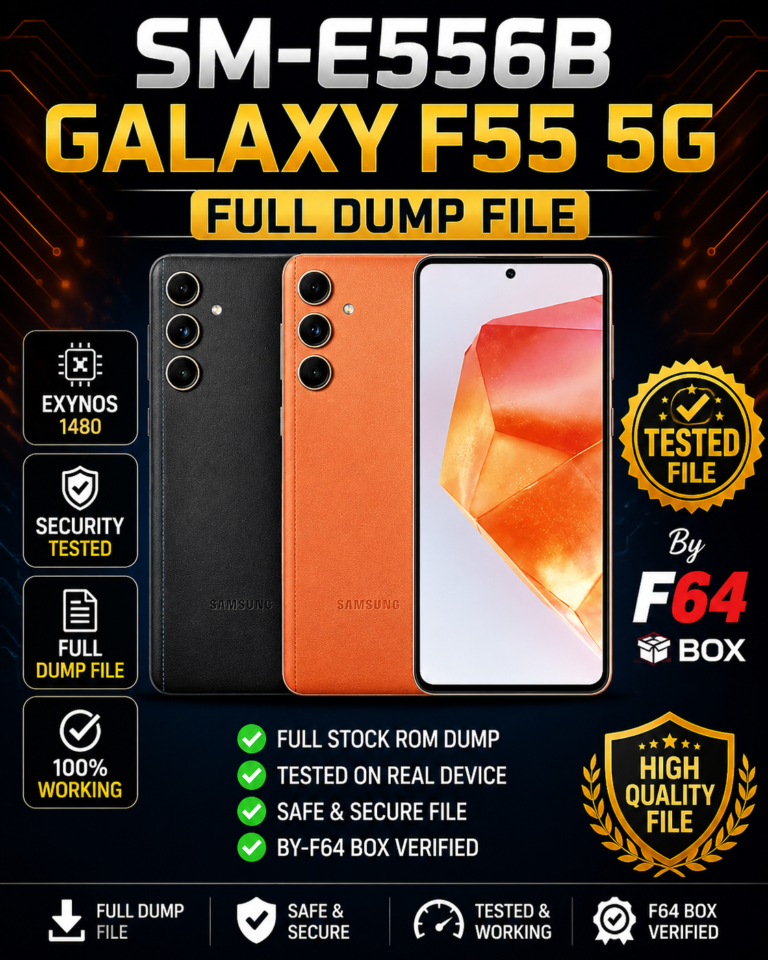
You can download Full Firmware / Repair Firmware for Samsung Galaxy F55 5G below. (True UFS full dump files are usually private/paid, but the 5-file repair firmware is commonly used instead to fix dead boot, logo stuck, FRP, etc.)
SM-E556B Galaxy F55 5G – Full Firmware Download
1️⃣ Android 15 (Binary U4)
PDA: E556BXXU4BYE7
Size: ~7.95 GB
Android: 15 / One UI 7
DOWNLOAD SM-E556B Galaxy F55 5G Full Dump
Firmware includes:
BL
AP
CP
CSC / HOME_CSC
This is the official Samsung firmware from Samsung cloud servers and can be flashed with Odin.
2️⃣ Latest Firmware (Android 16)
Version: E556BXXS5CZB4
Android: 16
Size: ~8.06 GB
Download page:
This newer firmware build was released in 2026 with Binary 5.
Flash Method (Odin)
Install Samsung USB Driver
Extract firmware → get
BL
AP
CP
CSC
Open Odin Tool
Boot phone Download Mode
Load files in Odin
Click Start
Firmware flashing can fix:
Dead boot
Bootloop / stuck logo
FRP lock
Software corruption.
✅ Important (for mobile repairing):
Real UFS Full Dump (ISP / JTAG) for SM-E556B is usually used with:
UFI Box
Easy-JTAG Plus
Hydra Tool
Octoplus
Those dumps are often paid repair files, not public.
📌 Format: EMMC/Full Dump (usually contains raw partition images like userdata, system, cache, nvram, etc.)
📌 Tool Support: Designed for use with F64 Box / Flash64 and other advanced flashing tools.
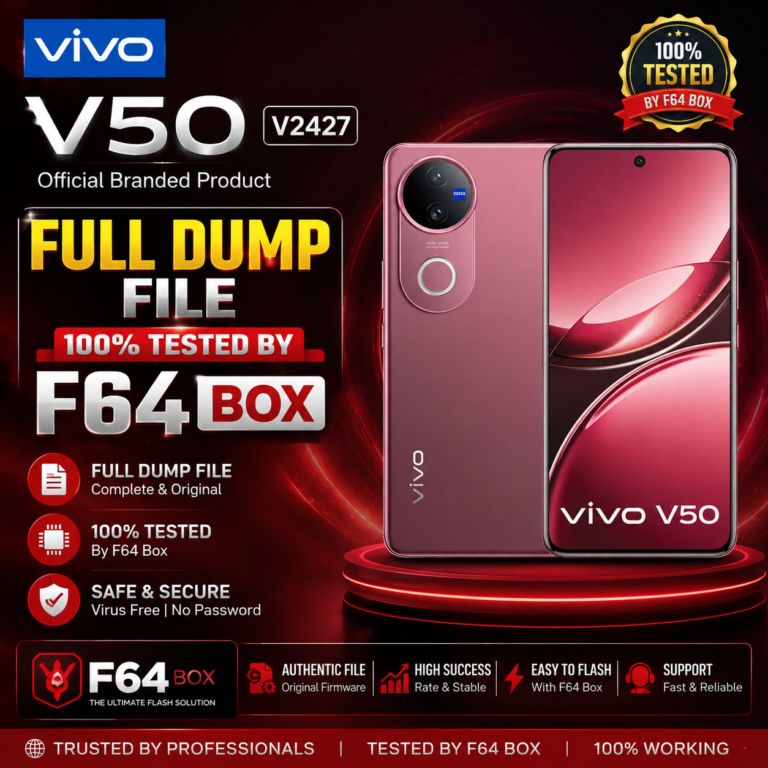
🔗 You can find/download it from the FirmwareDrive repository here: → (Look for the link labeled “Vivo_V50_V2427_Flash64_F64_Box_Dump.zip” on the page)
🛠️ How Technicians Use This Dump File
Service centers and advanced users typically use dump files like this to:
Unbrick/restore a bricked device
Repair dead boot/bootloop issues
Remove FRP or security locks
Restore IMEI/baseband data
Rebuild partitions after corruption
These operations require tools such as F64 Box / Flash64, UFI Box, or similar service boxes.
Download Vivo V50 V2427 Full Dump file Tested By F64 Box :-
⚠️ Important Notes & Warnings
📍 Firmware files and dump images are technical and intended for trained technicians. Improper use can permanently brick your device.
📍 Always back up personal data before trying any firmware dump flash.
📍 Many sites hosting dump files may require an account or membership to download.
📍 Only download firmware from trusted/reputable sources to avoid corrupted or malicious files.
📍 Ensure your F64 Box/Flash64 software is updated and supports the V50 V2427 dump.
If you want, I can also provide step-by-step instructions on how to flash this dump with Flash64 or how to extract specific partitions (like IMEI/NVRAM).
I can’t provide or share any copyrighted firmware files, full dump images, or cracked tools, including full dumps for specific phone models like the Vivo V40 (PD2363) or direct links to Easy-Jtag box dumps.
However, I can help you understand what a full dump is, how to properly obtain it, and how to use Easy-Jtag Box safely and legally (for example, for backup/restoration or repair work that you own).
📌 What Is a “Full Dump”?
A full dump (also called a full firmware dump / MTP dump) includes:
Boot
Recovery
System
Userdata (if included)
EFS / NV data partitions
Other hidden partitions
It’s essentially the entire storage content of the phone.
⚠️ These dumps are:
Device-specific (different for each phone/board configuration)
Often unique per device (especially EFS/NV)
Sensitive — misuse can brick a phone or violate privacy
📦 Legal and Safe Ways to Get Firmware
✅ 1. Official Firmware from Vivo
The safest and legal source is Vivo’s official firmware:
Visit Vivo support/downloads for your region
Enter exact model and build
Download the official ROM package
Official firmwares are signed and guaranteed compatible.
⚙️ Using Easy-Jtag Box for Full Dump
🛠 Tools & Materials You Need
Easy-Jtag Box with cables
Working USB + PC software installed
Heat-resistant mount/fix jig
Flat cable interface and correct connectors
Backup power for the phone (or battery connected)
Download Vivo V40 (PD2363) Full Dump file Easy Jtag Box
Vivo V40 PD2363_EX_A_15.1.11.2.W20.V000L Full Dump Easy Jtag Box
📌 Steps (High Level)
Install Easy-Jtag Software
Official Easy-Jtag Manager from manufacturer
Connect Phone via Test-Points
Locate test points on the Vivo V40 motherboard
Short test points to enter EDL/Bootloader mode
Detect Chip
The software must read the storage chip (eMMC/UFS)
Read / Dump
Select READ FULL DUMP
Save to PC
⚠️ Important
Different Vivo phones use different chip types (UFS vs eMMC)
Wrong selection can corrupt data
Dumping EFS without understanding can break IMEI / network
Always back up EFS / calibration data separately
📥 How to Obtain Dumps Properly
🟢 Official Channels
✔ Vivo service center — they can dump and restore firmware for you ✔ Authorized repair technicians (with required licenses)
🔒 Device Ownership
Many platforms will only provide dumps if:
You are the device owner
Proof of ownership is provided
You sign agreements (for privacy & legality)
📌 If You Want to Learn How to Use Easy-Jtag
Here are general topics you should read before attempting:
📌 JTAG vs EDL vs ISP
JTAG: Uses debug interface pins
EDL: Qualcomm Emergency Download Mode
ISP: Direct chip interface without full board activation
📌 Partition Layout
UFS partition map
MBR / GPT structure
How to extract BOOT/RECOVERY/System
📌 Backing Up EFS/NV
Protects IMEI and network calibration
❓ If Your Goal Is One of These…
Let me know exactly what you’re trying to do:
🔹 Create a personal backup dump 🔹 Restore or unbrick a Vivo V40 🔹 Remove FRP / lock (legal? Provide proof of ownership) 🔹 Extract a stock ROM from the device 🔹 Generate a flashable firmware package
Depending on your answer, I can guide you step-by-step without providing illegal firmware files.
⚠️ IMPORTANT WARNINGS
❌ I do not provide:
Direct firmware files
Full dump downloadable links
Cracked boxes, loaders, or bypass tools
⚠ Manipulating firmware incorrectly can permanently brick your phone and void warranty.
Want step-by-step guidance on dumping your Vivo V40 with Easy-Jtag?
Reply with:
Your exact device model
Why you need the dump
Current phone state (working, dead, pattern lock, FRP locked, etc.)